Loading operating surface


Systown PLANT · In development
See your plant.
Test the next move.
From a single process to a moving warehouse. Build your operational model, explore what could change and compare the evidence—before committing to a real-world trial.
01 / MODEL
See the whole operation.
02 / SIMULATE
Explore the trade-offs.
03 / REVIEW
Make the next move count.
The value of a better experiment
Find the bottleneck.
Before it becomes the plan.
A new layout. A different fleet. A process change. PLANT gives your team a shared place to explore the trade-offs before investing in a site trial.
Throughput
See what holds the flow back.
Compare layouts, dispatch choices and process parameters. Use simulated outcomes to decide which changes deserve closer investigation.
Safety
Make interactions visible.
Explore shared routes and conflicts between simulated people and machines. Bring better questions into the site’s formal safety assessment.
Control
Keep the decision yours.
Review assumptions, preserve model revisions and retain the evidence behind a proposal. Your team decides what advances to a real-world trial.
Benefits are objectives to evaluate. Simulation results do not establish site performance or certify safety.
Industrial Physical AI · REAL → SIM → REAL
Understand the operation.
Prove the next move.
More productive fleets. Better-informed decisions. Control that stays with you. Systown connects industrial data, spatial intelligence and world models to turn your operational question into a plan you can inspect.
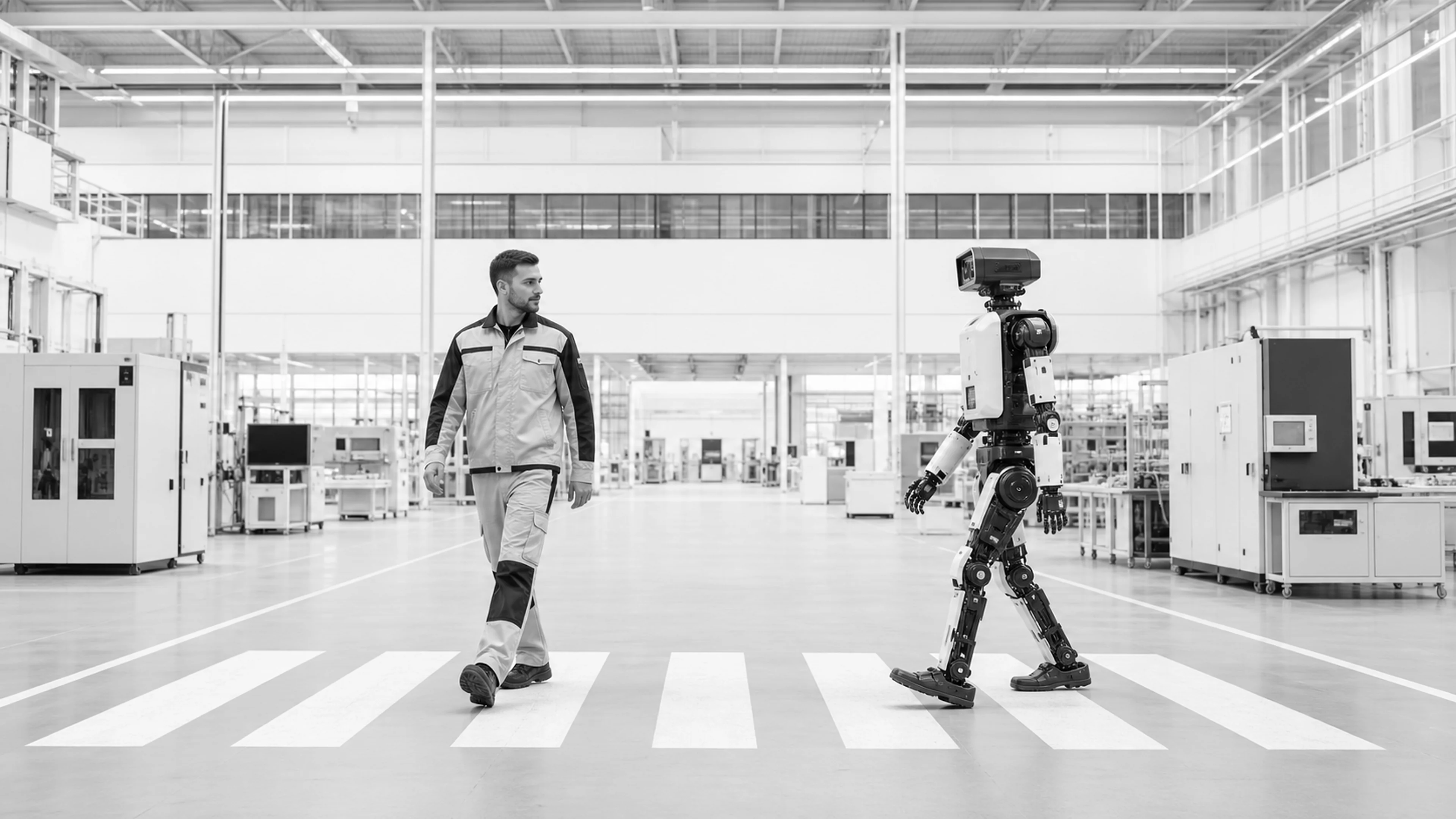
01 · REAL
Understand the operation.
Connect industrial history and measured position through site-specific integration paths. missionGRAPH relates observations to assets, places and processes.
AVEVA PI + Wittra 4D
Shared awareness
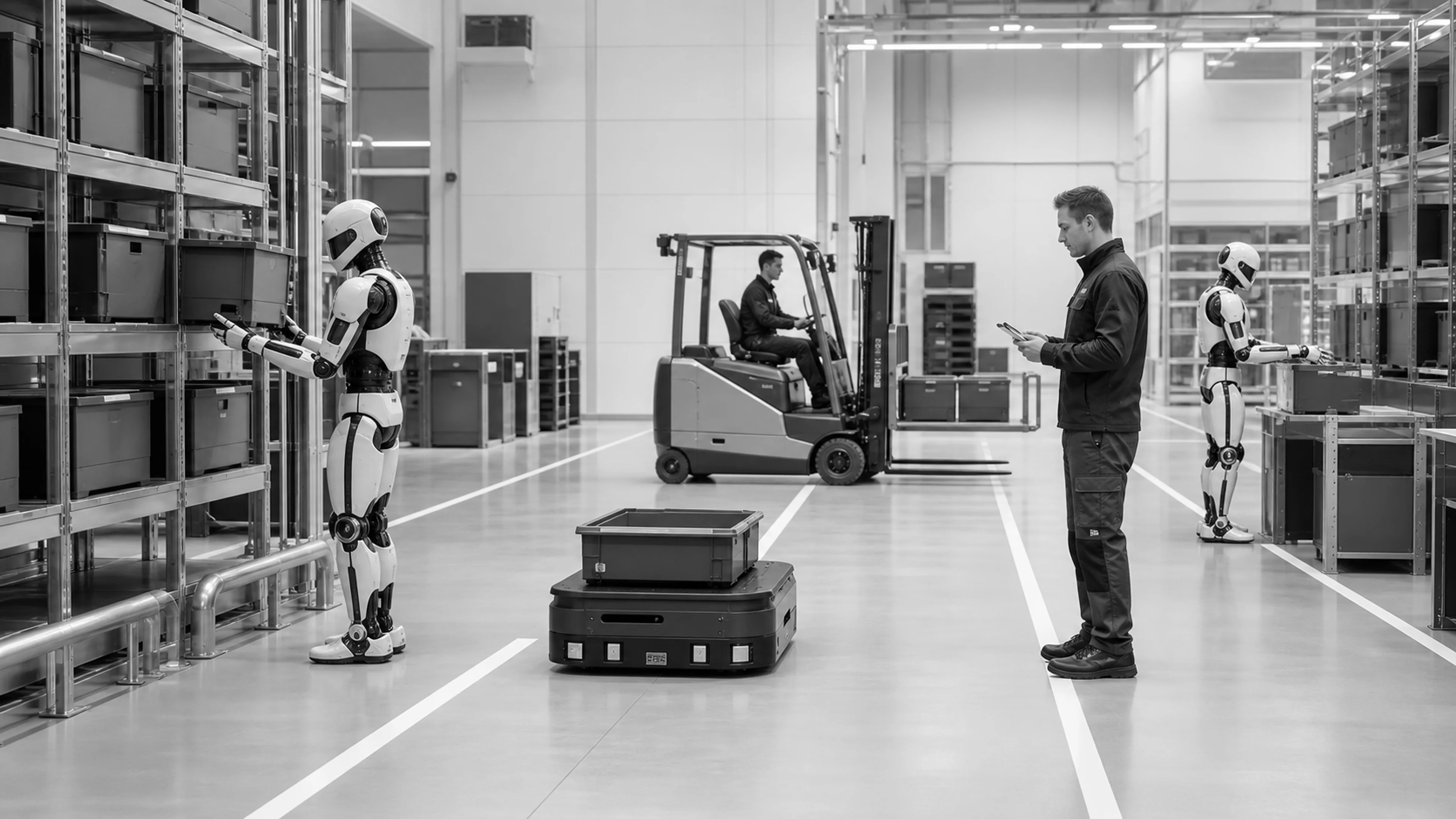
02 · SIM
Test the next move.
Compare baseline and candidate fleet plans in bounded simulation. World models offer a future path for richer prediction and scenario exploration.
Systown simulation · World-model direction
Evidence before action
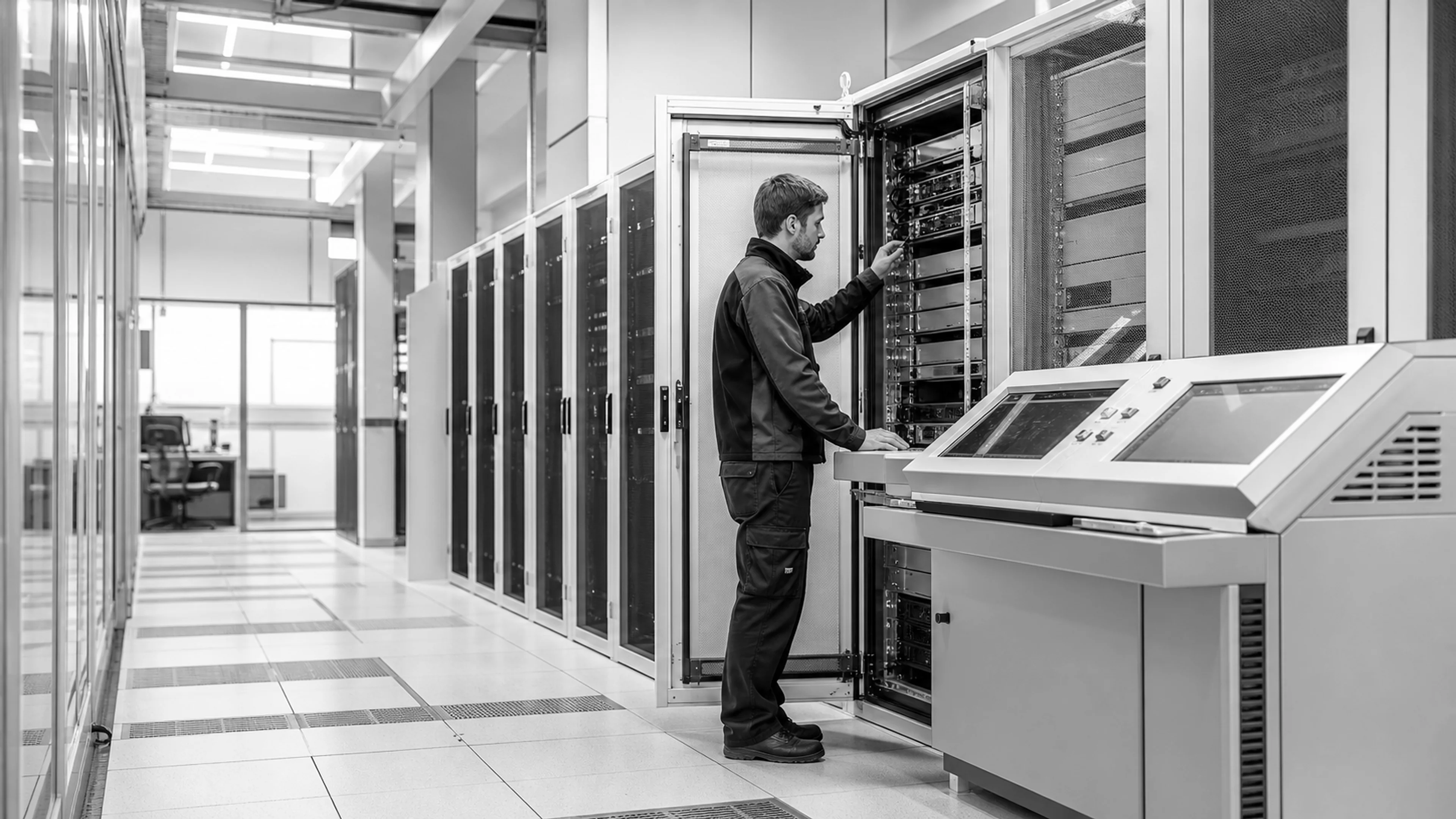
03 · REAL
Coordinate with control.
Review a proposed plan and its evidence. A real-world trial requires commissioned connections, validated controls and explicit approval.
swarmCORTEX + your operating rules
Your site. Your authority.
REAL → SIM → REAL is the development direction. PLANT currently supports local modelling, simulation and review. Physical execution and GPU-trained autonomy are future stages; simulation is not field validation.

Model the operation
One process.
Every connection.
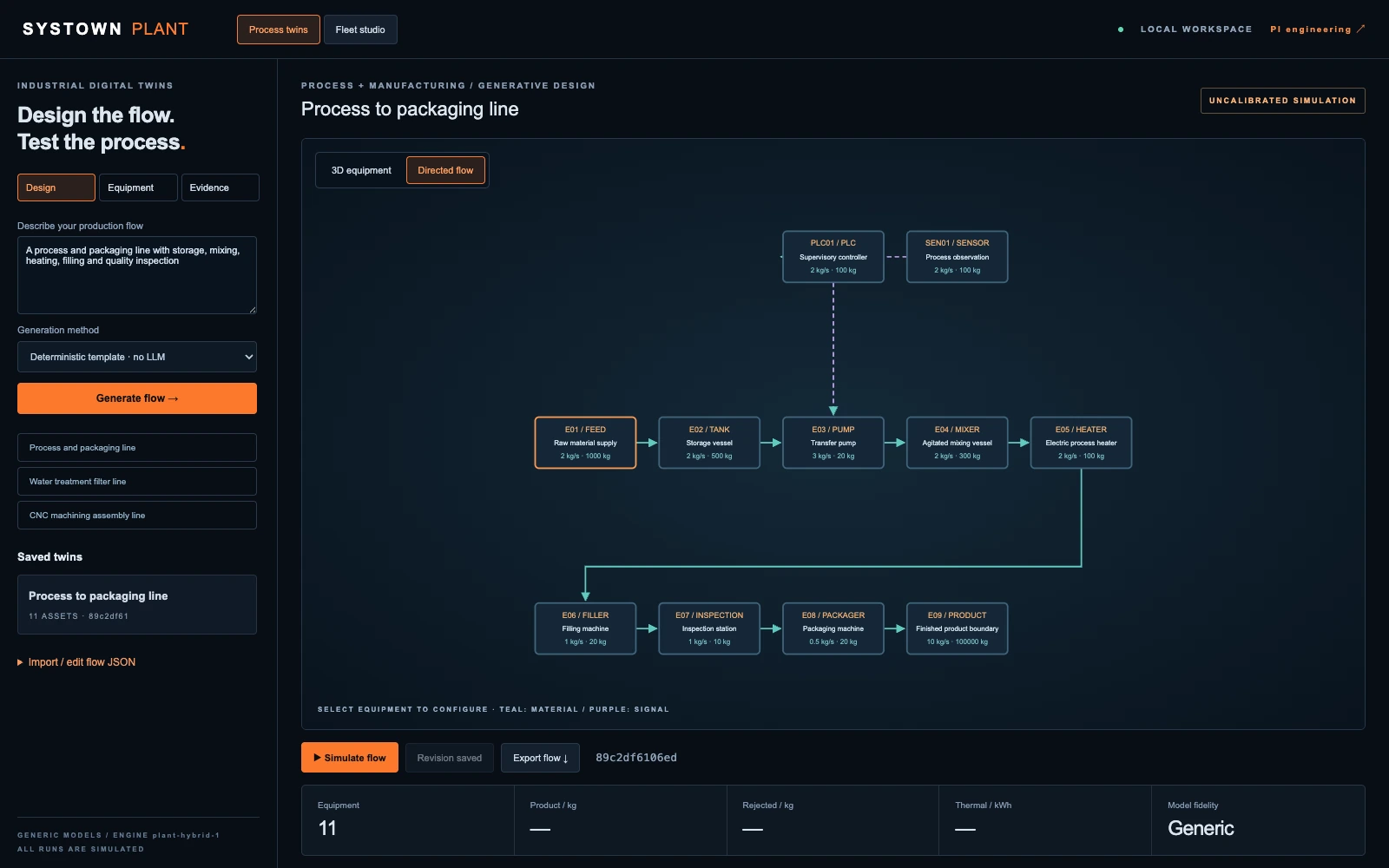
A change at one machine reaches far beyond it. Build connected equipment models and move between flow diagrams and 3D views to see how material moves through the operation.
For process and manufacturing teams exploring flow, capacity and equipment dependencies.

Explore the alternative
Change a parameter.
See what follows.
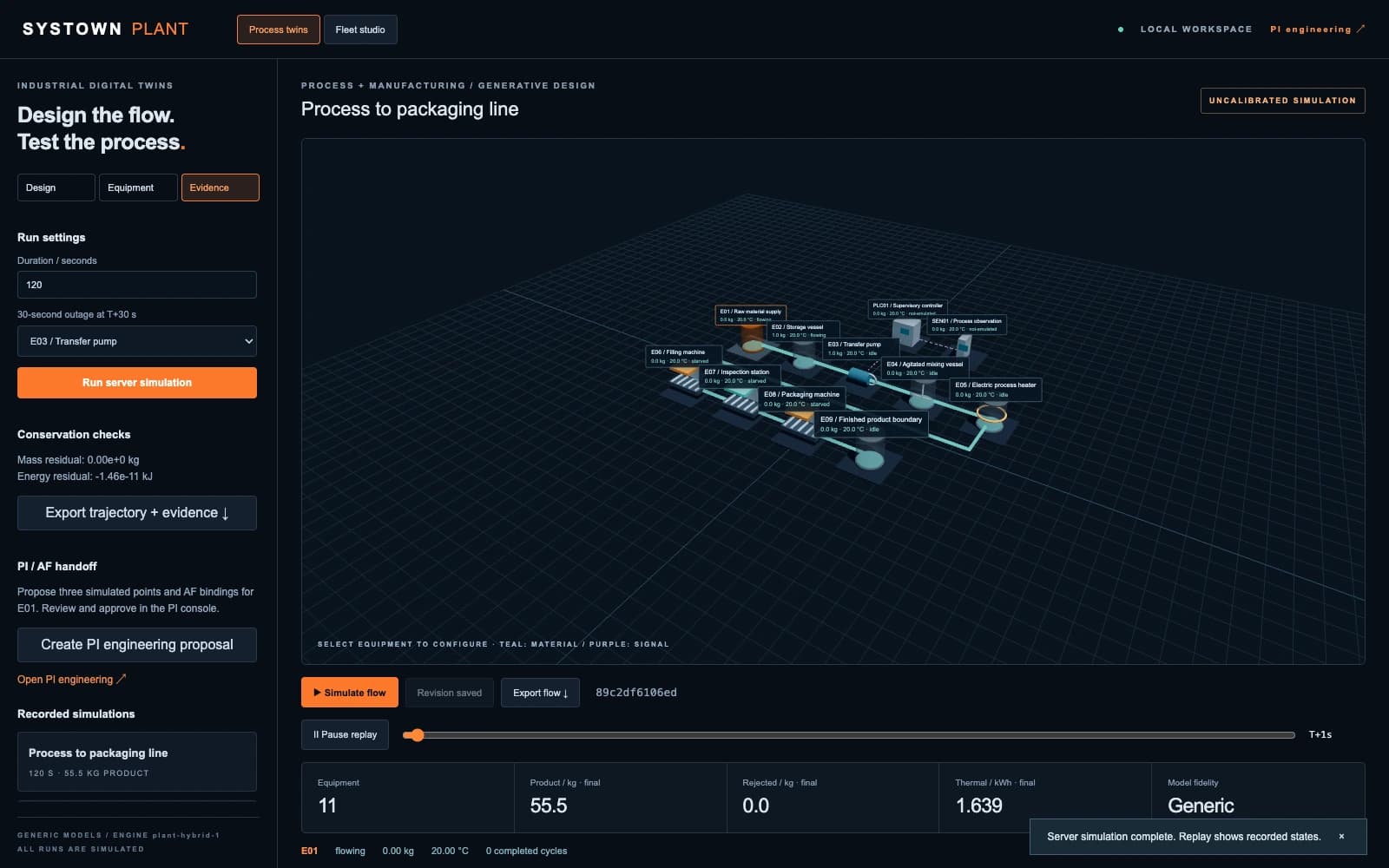
Introduce a fault. Run a scenario. Replay the result. Explore how a proposed change behaves before you decide what deserves a real-world trial.
Bounded, generic process models. Their outputs describe the scenario—not measured plant performance.
Explore the warehouse
From the whole floor.
To the next aisle.
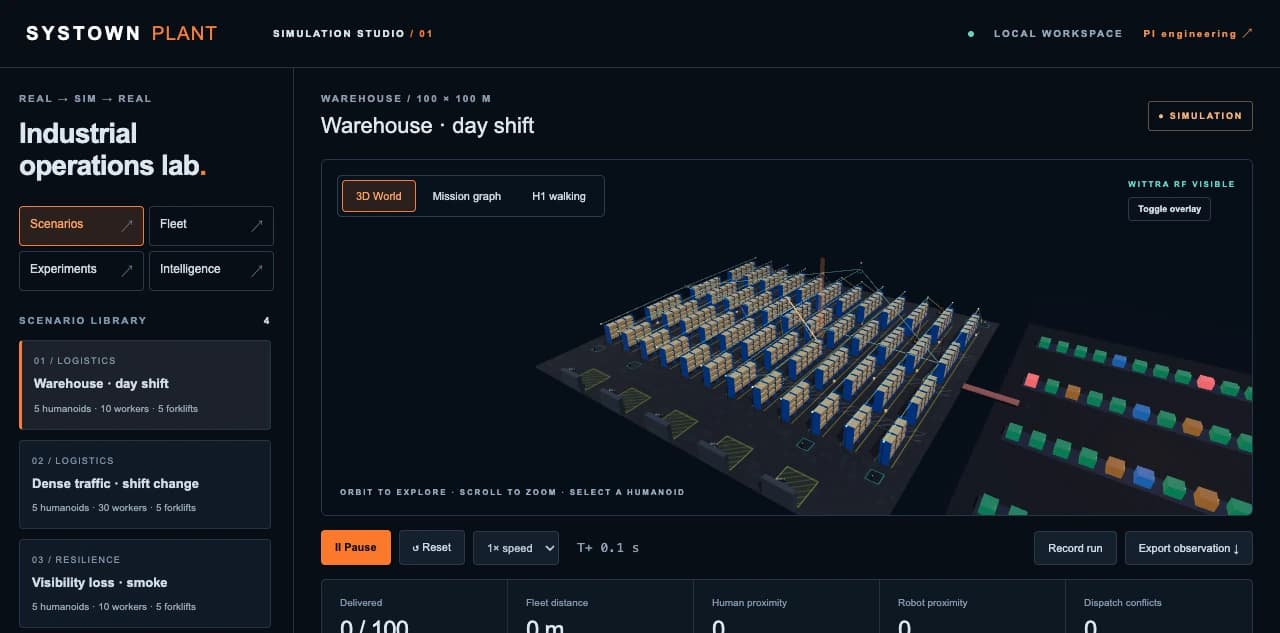
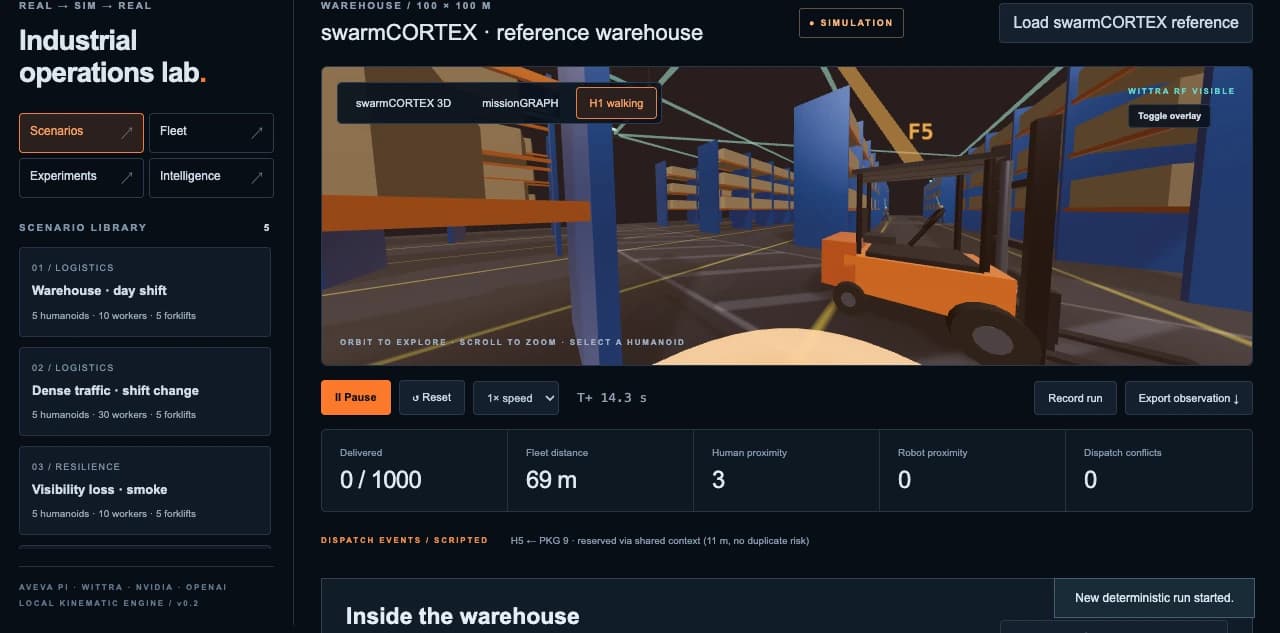
Move from an overhead view to aisle level. Follow simulated people, forklifts and humanoids over time. Compare supported fleet scenarios and see how the operation unfolds.
For warehouse and automation teams investigating layouts, traffic and dispatch decisions.

Connect the context · missionGRAPH
A reading is a number.
Context makes it useful.
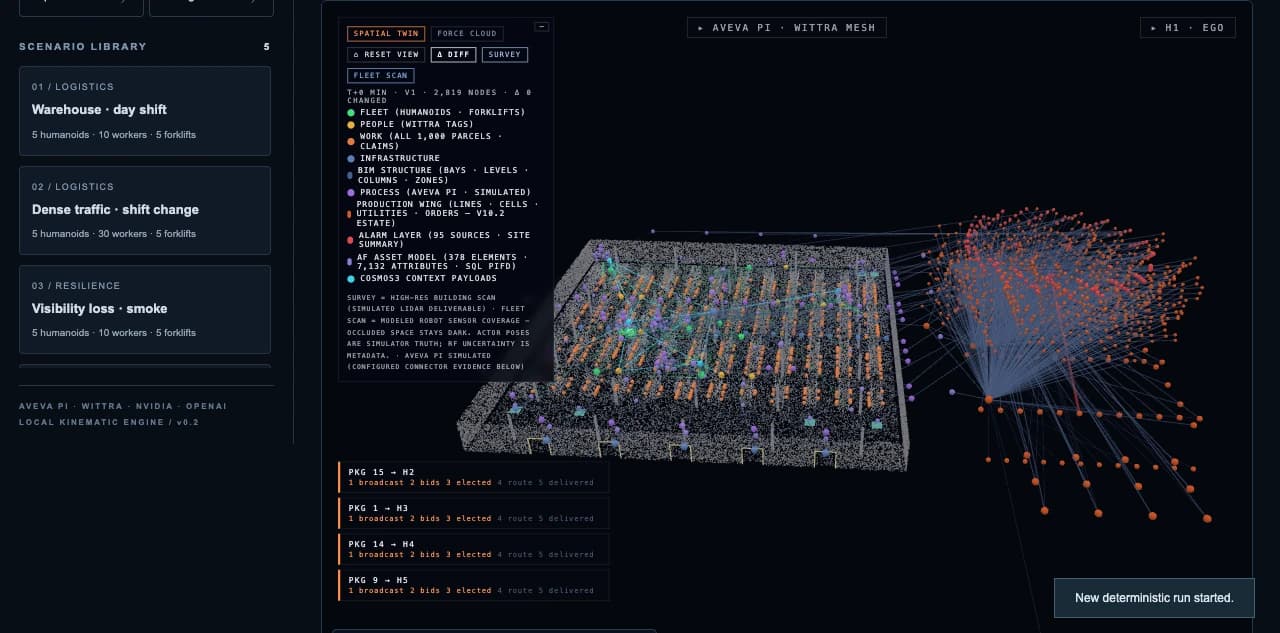
Connect assets, space, process and work. Explore their relationships in missionGRAPH, with the source of each observation visible as you move between operational context and simulation.
PI/AF and Wittra integration paths require access, configuration and site validation. Spatial integration also requires frame calibration.

Make the next move reviewable
Ask. Compare.
Decide with evidence.
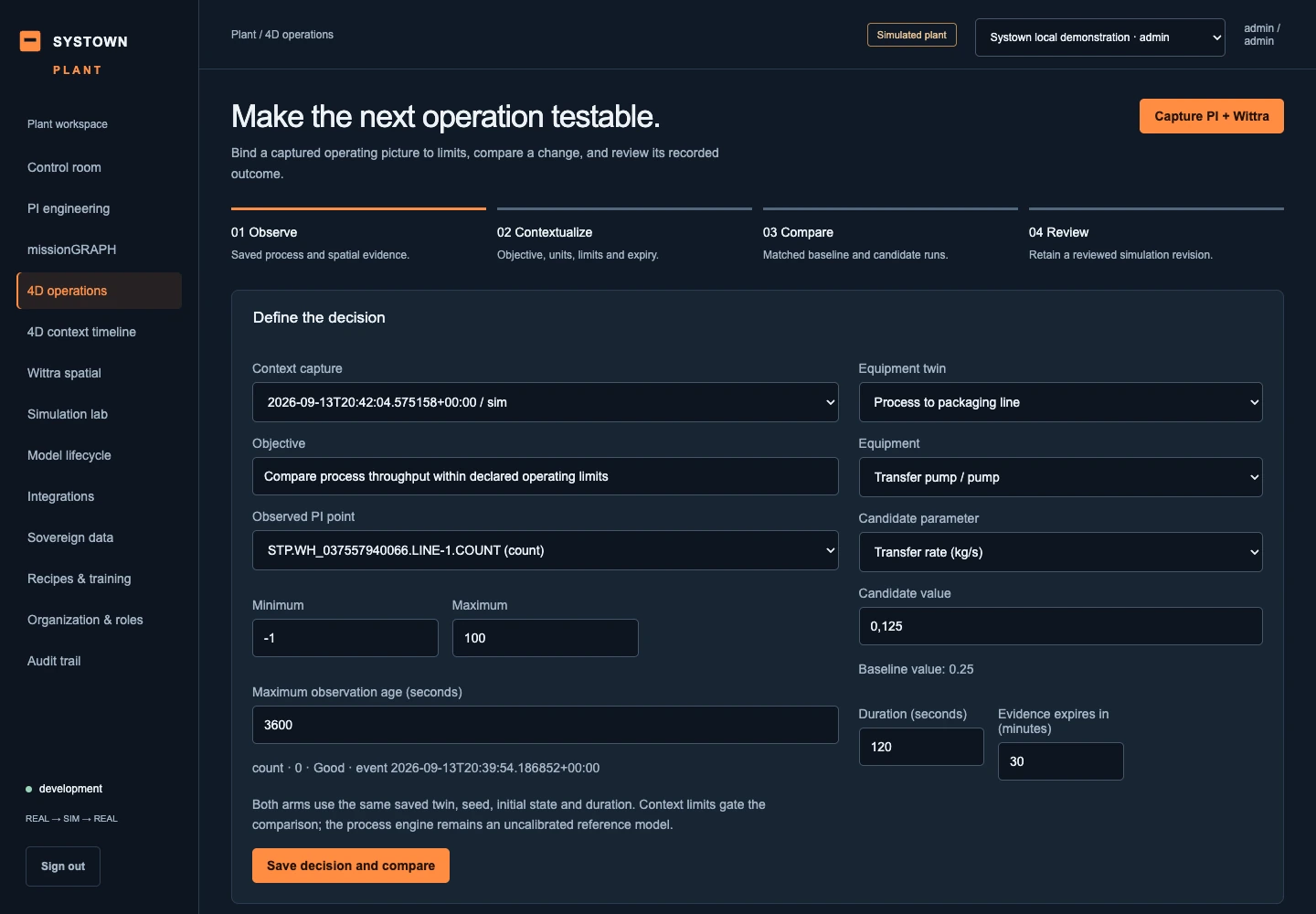
Start with the available context. Define the objective and limits. Compare baseline and candidate scenarios from the same saved starting point. Review the outcome before taking the next step.
Configured PI/AF changes use a separate proposal → dry-run → approval → execution → readback process. A simulation result never authorises a physical action.
Keep the reasoning
Every experiment.
A history you can return to.
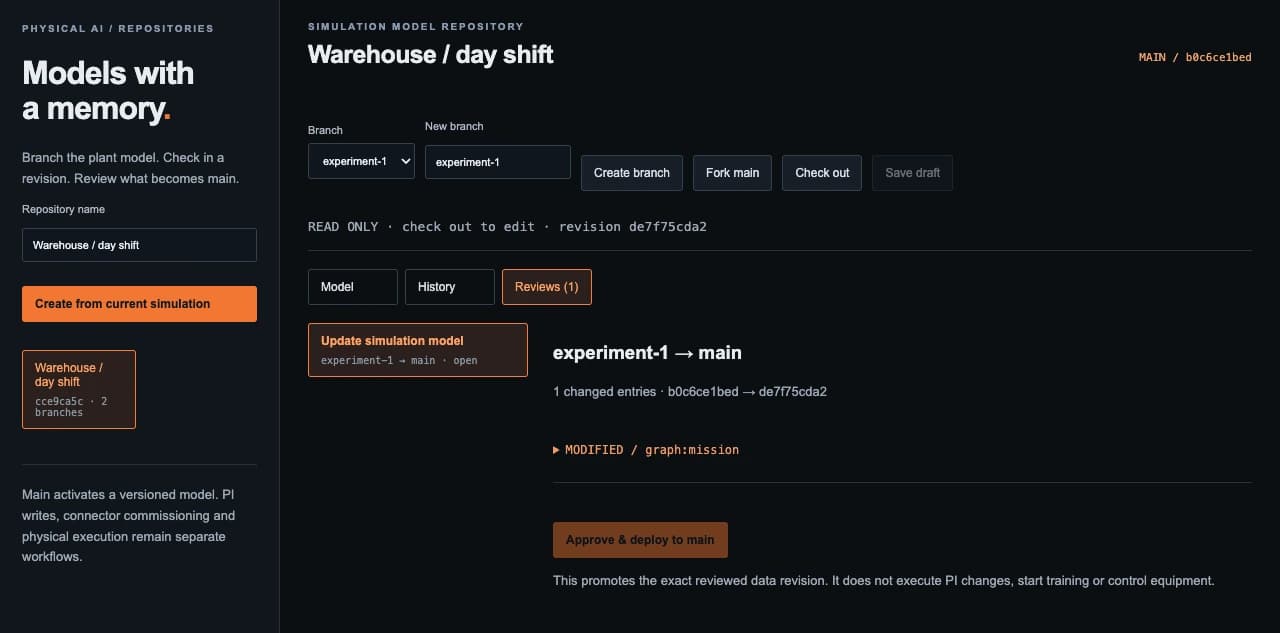
Branch a model. Save a revision. Review what becomes the shared starting point. Keep recorded runs and model history together so the next decision can build on the last.
Model promotion changes the local workspace. It does not deploy to a plant, write industrial data or control equipment.
One product · Connected capabilities
Industrial memory.
Spatial understanding.
AVEVA PI brings the history. Wittra brings the sense of where. PLANT brings modelling, context and scenario review into the same conversation.
AVEVA PI / AF · Industrial data
Relate time-series signals to equipment and process structure. autonomousPI MCP and agenticOPS support the industrial-data and agent-workflow direction within the PLANT story.
Wittra · Spatial context
Connect measured positions and sensor observations to the model. A useful connection needs timestamps, quality, coordinate calibration and site validation.
missionGRAPH · Shared context
Connect assets, locations, streams and work in a queryable operational graph. Understand what a signal describes and where its evidence comes from.
swarmCORTEX · Fleet coordination
Explore shared assignments, routes and reservations in simulation. NVIDIA Cosmos world models are part of the broader development direction for Physical AI.
Integration paths require configuration, permissions and commissioning. Product screenshots show local simulation—not installed live integrations or physical control.

From exploration toward commissioning
Built to ask better questions.
Developed with clear boundaries.
Systown PLANT brings working local modelling, simulation and review workflows into one development-stage platform. The next step is learning which operational questions matter most to your team.
Working locally
Model. Simulate. Review.
3D process and warehouse workspaces, bounded scenarios, recorded replay and versioned model review.
Site-specific validation
Connect with confidence.
Industrial connections require configuration, permissions and commissioning. Site predictions need calibrated models and measured validation.
Future stages
Advance deliberately.
Physical equipment control and GPU-trained autonomy are future stages. The product previews on this page show simulation.
Systown PLANT · Waitlist open
Bring your next
operational question.
What would you like to model, simulate or understand? Join the waitlist for product updates and information about future pilot opportunities.
For process engineers, warehouse and automation teams, and the people connecting industrial data to decisions.
Confirm your email to join. You can unsubscribe at any time. Joining does not guarantee pilot access or a launch date.
Questions, answered
Know what you’re exploring.
Before you join.
Is this a live plant control system?
The current workspace supports modelling, simulation and reviewed engineering workflows. It does not provide physical actuator control. Live industrial integrations require their own commissioning and permissions.
Can I connect AVEVA PI and Wittra?
The platform includes PI/AF and Wittra integration paths. Each installation needs the relevant access, configuration and validation; spatial use also requires frame calibration. The screenshots on this page use simulation data.
Are the simulation results predictions of my plant?
The included process models are generic and uncalibrated, and the reference warehouse uses kinematic simulation. Site-specific predictions require appropriate models, calibration and validation against measurements.
How is AI used?
Configured model providers can propose structured plans and model content. Model output is validated as bounded data. It does not directly execute shell commands or control equipment. Authoring capabilities depend on the supported model schema and configured provider.
What happens after I join?
Confirm your email address to join the Systown PLANT waitlist. We will share product updates and information about pilot opportunities as they become available. You can unsubscribe at any time. Joining does not guarantee pilot access or a launch date.
What is Physical AI?
Physical AI is artificial intelligence that uses observations of the physical world to perceive, reason, plan and guide physical actions. Examples include a robot handling a component or an autonomous vehicle navigating a warehouse. It combines sensing with models and control systems; its decisions must account for physical constraints, uncertainty and people nearby.
What is a world model in AI?
A world model is a learned representation of an environment that can predict how it may change over time, sometimes in response to an action. In Physical AI, world models help explore possible outcomes, generate training scenarios and support planning. For example, a model can predict how a warehouse scene might change as a vehicle moves. Predictions require validation against observations; plausible output is not proof of physical accuracy.
What is Industrial Autonomous Physical AI?
Industrial Autonomous Physical AI applies perception, reasoning, planning and bounded action to physical operations in factories, warehouses, process plants and infrastructure. It connects industrial data, spatial context and operational objectives so systems can respond within an explicitly authorised scope. For example, a fleet could propose a new route around a blocked aisle. Autonomy depends on validated controls, permissions and site-specific commissioning; it does not mean unrestricted machine control.
What is spatial intelligence in industrial AI?
Spatial intelligence is the ability to understand positions, geometry, movement and relationships in a physical environment. In industry, it helps answer which vehicle is approaching a crossing, which asset occupies a work zone and whether a route is clear. Cameras, LiDAR, RF positioning and maps can contribute. Useful spatial context includes timestamps and uncertainty, because a position that is stale or imprecise can lead to a poor decision.
Why do industrial AI systems need missionGRAPH?
Industrial AI needs shared context to connect a reading or observation to the asset, place, time and operation it describes. missionGRAPH is Systown’s context layer, designed to connect assets, people, machines, spatial observations and industrial streams in a queryable graph. For example, it can relate a temperature reading to a pump, its location and the process it serves. The value is traceable relationships and data freshness, rather than isolated signals.
Why do autonomous fleets need swarmCORTEX?
When several robots, vehicles and people share a site, each task competes for routes, space and resources. swarmCORTEX is Systown’s coordination layer for shared assignments, routing and reservations, with agentic supervision and decision evidence. A warehouse example is coordinating two robots that need the same aisle. Reported performance improvements belong to the evaluated simulation scenarios; field performance requires separate validation and commissioning.
What are real-time industrial data streams?
Real-time industrial data streams are ongoing sequences of timestamped observations and events from equipment and operational systems. Examples include pump vibration, motor temperature, power consumption, valve position, alarms and vehicle location. Each observation needs an identity, timestamp, value, unit where applicable and quality information. Real time means timely enough for the use case: a maintenance trend and a robot control loop have very different latency requirements. A live data feed alone does not provide a hard real-time control guarantee.
What does contextualisation mean in an industrial setting?
Industrial data contextualisation connects raw measurements and events to the assets, processes, locations and operating conditions that give them meaning. A value of 85 is ambiguous; 85 °C from the drive-end bearing of Pump P-101 during startup, recorded two seconds ago with good sensor quality, is actionable context. Asset hierarchies, engineering units, timestamps, relationships and provenance help people and AI interpret the same signal consistently. Contextualisation, also spelled contextualization, supports diagnosis and planning.