Loading operating surface

Products · Products
autonomousPI MCP
AVEVA PI Autonomous Infrastructure.
An MCP agent on your AVEVA PI Data Infrastructure — any plant, any Asset Framework, an unlimited number of points and context structures. It creates, manages, analyses and forecasts PI data in plain language, over the PI Web API you already run.
Model Context Protocol serverUnlimited PI pointsAny AF context structureCreate · manage · analyse · predictClaude Fable 5.1 · ChatGPT · Gemini · Astra 6Read-only by default
What it does
Talk to your PI data. Then let it work.
autonomousPI MCP is a Model Context Protocol server over the AVEVA PI Web API. Point it at any PI Data Infrastructure — one site or a hundred, ten thousand points or ten million — and every element, attribute and point in your Asset Framework becomes something an agent can find, read, trend, create and forecast. No schema to build, no query language to learn: the context structure you already maintain is the context the agent uses. Model-agnostic by design: use it with Claude Fable 5.1 and Claude Code, OpenAI ChatGPT, Google Gemini, Astra 6 or any other MCP client.
01
Talk to your data
Ask in plain language — from Claude Fable 5.1, Claude Code, OpenAI ChatGPT, Google Gemini, Astra 6 or any MCP client. The agent browses your Asset Framework, resolves the question to the exact tags, pulls live values and trends, and answers with the number, the unit, the tag name and a chart. It never invents a tag.
02
Autonomous engineering
Create points. Provision whole AF-structured estates from a template — thousands of elements, each with its attributes, every attribute backed by a new PI point — in one call. Build and extend the context structure that used to take months.
03
Prediction, out of the box
Google TimesFM, a time-series foundation model, forecasts any PI point zero-shot — no training on your data, no data-science project. Minutes and hours ahead, with p10–p90 bands, for as many points as you have.
04
Unlimited, and bounded
No cap on points, elements or context structures — the PI Web API is the only limit. Read-only by default; writes only within explicit scope. Runs on your infrastructure, on-prem or air-gapped. Every answer states which backend served it.
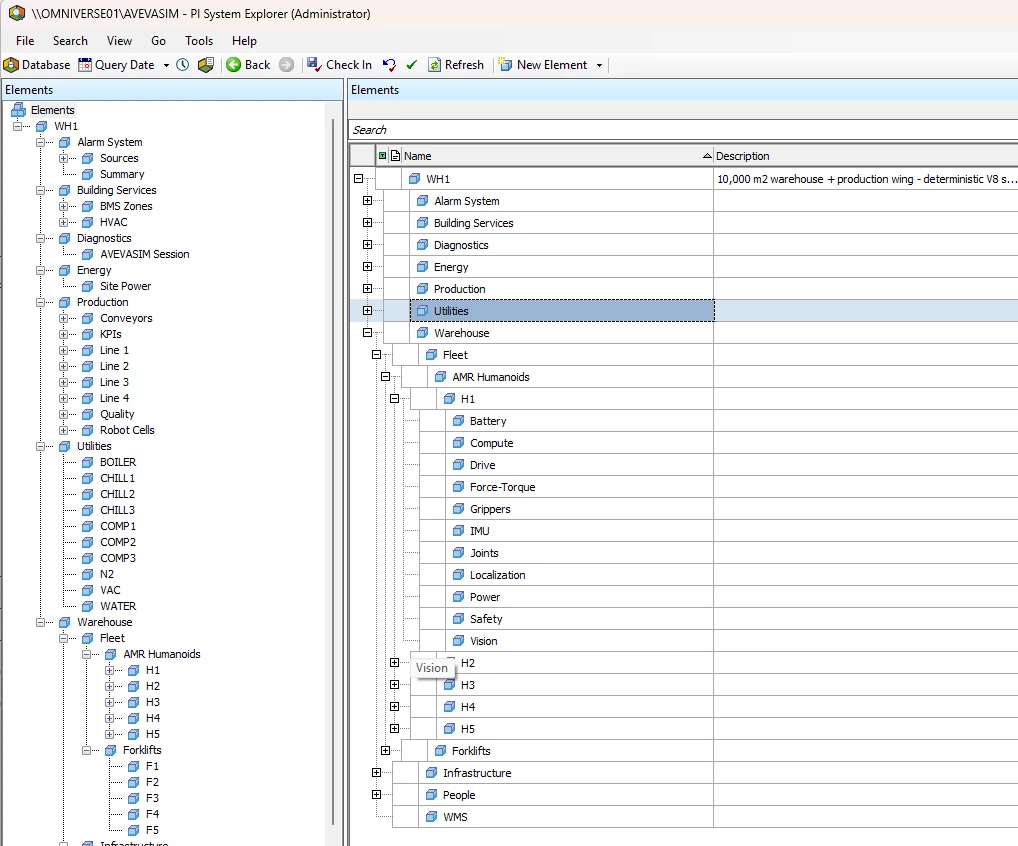
On screen · 01 / 04
Any namespace. Any number of points.
The Asset Framework is the context structure your plant already has: sites, areas, units, lines, machines, utilities, fleets, people — elements with attributes, each attribute backed by a PI point in the Data Archive. autonomousPI MCP reads that structure as it is. It does not need a copy, a schema, a data lake or a model of your plant; it needs the PI Web API and read permission. Whatever your tree looks like — a single line or a global estate with millions of points across dozens of servers — the agent navigates it the same way: root, children, attributes, tags, live values. A question in plain language resolves down that tree to the exact points and back up with the answer. The example here is a warehouse and production estate with alarms, building services, energy, production lines, utilities and a robot fleet, around 20,000 points on one server. Yours can be ten times that, or a thousand times that. There is no cap in the product; the only limits are the ones your PI infrastructure already has.
- Unlimited points, elements and context structures — the PI Web API is the boundary
- Any Asset Framework, any depth, any naming convention — read as is
- Browsed by the agent with pi_af_tree; found with pi_search_tags
- Read-only over the PI Web API by default
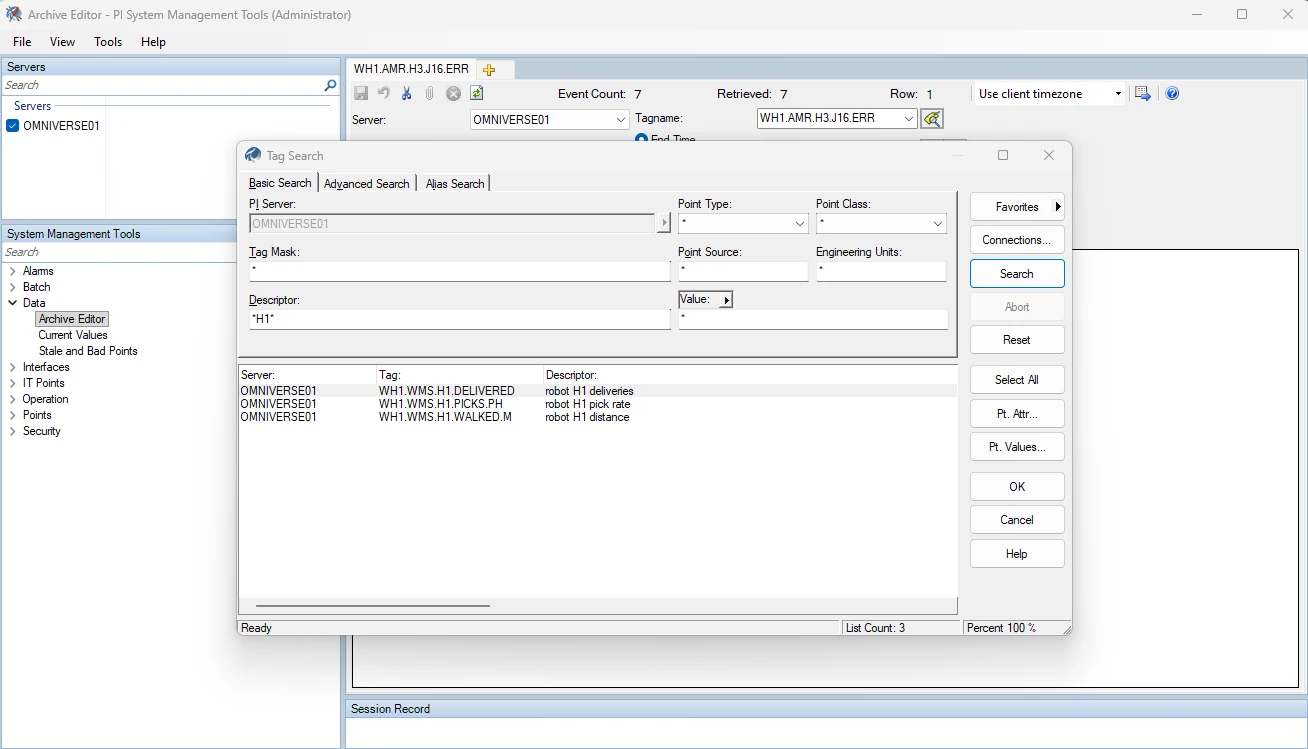
On screen · 02 / 04
Every tag findable. Every tag creatable.
Everything a PI engineer does by hand in System Management Tools — search tags by mask and descriptor, open a point in the Archive Editor, inspect its events, create new points — autonomousPI MCP exposes as tools an agent can call. Search becomes pi_search_tags. Reading history becomes pi_recorded_values and pi_summary with min, max, average, last value and trend. Creating points becomes pi_create_tags. And the work that used to take a project team months becomes one call: pi_bulk_provision — any number of elements under any parent path, each from one template with the same attributes, every attribute backed by a new PI point, the whole structure landed in the Asset Framework. A thousand cells with ten readings each is ten thousand tags; a hundred sites with a thousand assets each is a million. Same call. The example shows a tag search on one robot’s WMS points and an archive open on a joint-error tag; the operations are identical on any estate.
- Nine tools: estate stats · AF tree · tag search · values · series · summary · create · bulk provision · ontology
- Bulk provisioning of AF-structured estates at any scale in one call
- Every answer states which backend served it
- Model-agnostic: Claude Fable 5.1 · Claude Code · OpenAI ChatGPT · Google Gemini · Astra 6 · any MCP client
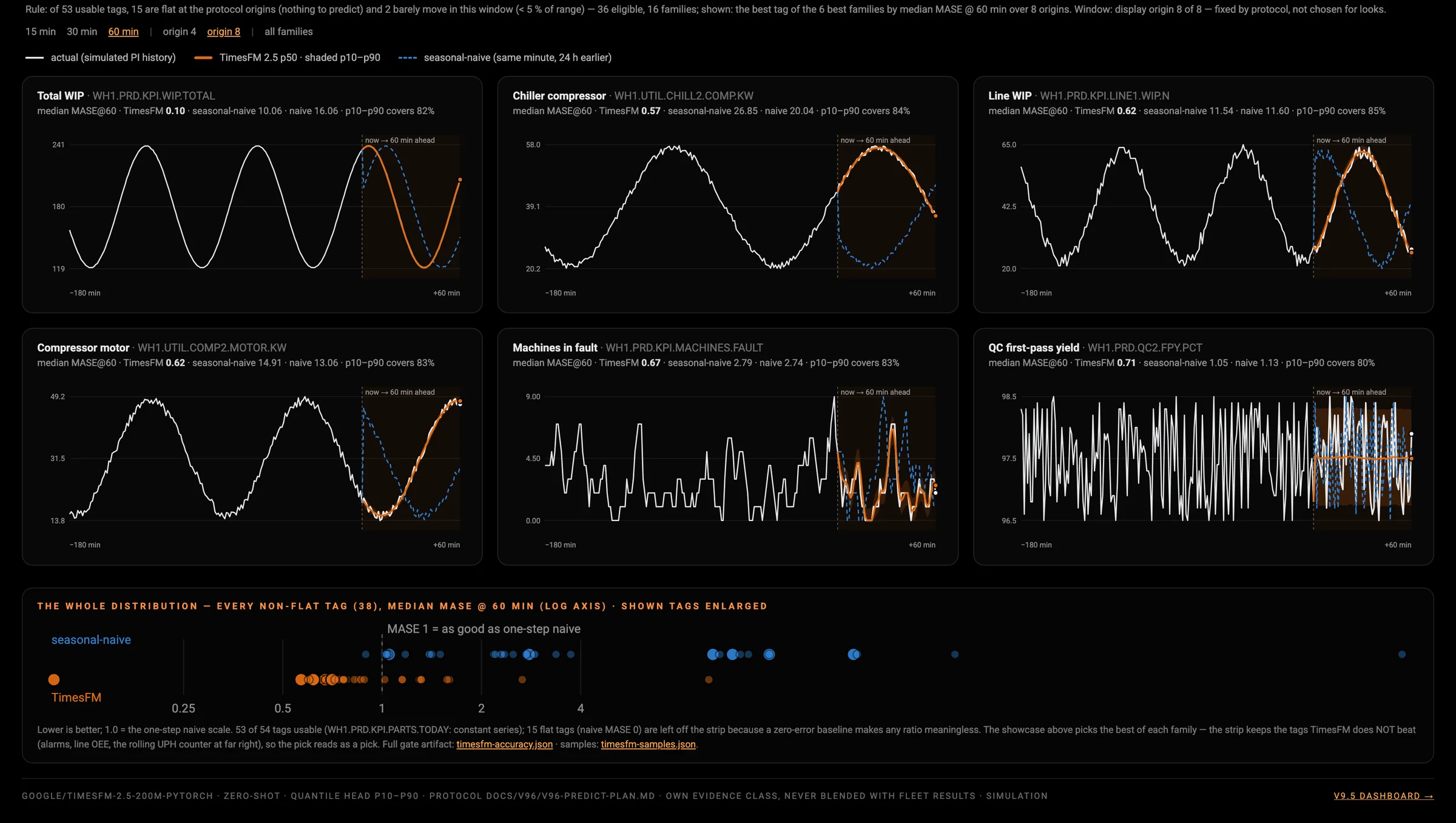
On screen · 03 / 04
Prediction, out of the box.
A time-series foundation model is trained once, on everything, so you do not have to train it on anything. Google TimesFM forecasts any PI point it has never seen — the next minutes and hours, with a p10–p90 band around the median — one call per tag, for as many tags as you have. In this example, six points from a production estate are forecast sixty minutes ahead from 2,048 minutes of history: white is the recorded PI history, orange the TimesFM median with its band, blue dashed the seasonal-naive baseline that has to be beaten. Smooth cycles are followed almost exactly; spiky counters are tracked where they can be; noisy signals are called flat because that is the honest call. Under the cards, every non-flat tag in the estate as a dot on a log axis of error, so the tags the model does not beat stay visible too. Point it at your compressors, your feeders, your lines, your chillers — the forecast lands on the same graph the world model and the agents read from, and prediction stops being a project.
- 200M-parameter time-series foundation model · zero-shot · no training on your data
- Any PI point, any horizon from minutes to hours, p10–p90 quantiles
- Example: median MASE 0.75 vs 2.30 naive · 304 of 319 windows passed the gate
- History in the example is simulated — labelled on screen
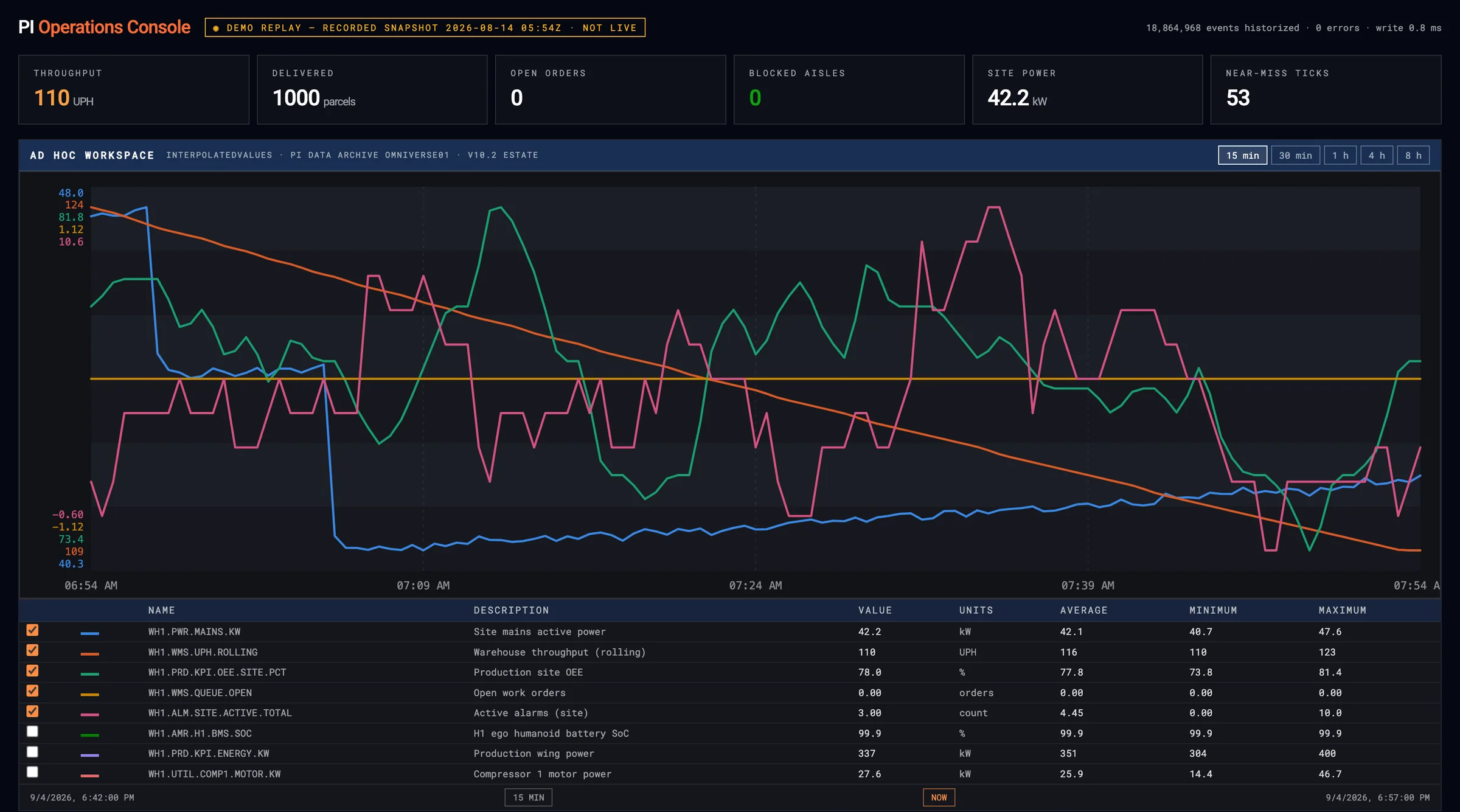
On screen · 04 / 04
The plant, right now — from any console.
autonomousPI MCP reads the same PI Data Archive your operations consoles read, through the same PI Web API, so what the agent says and what the control room sees are the same numbers. The example console trends site power, throughput, OEE, open work orders and active alarms with value, average, minimum and maximum over fifteen minutes to eight hours, alongside fleet, lane and dock state — tens of millions of events historized, interpolated on request. Swap in your own PI Vision displays, your own KPIs, your own estate; the agent does not care which console it sits beside. What it adds is the conversation on top: the same points, for any number of assets, asked for in plain language and answered with the number, the unit, the exact tag and a chart — and a forecast of where they are going.
- Same Data Archive, same PI Web API, same numbers as your consoles
- Interpolated and recorded values for any point, any window
- Example is a recorded snapshot — labelled, not live
- The surface the agents and the world model read from
Where it lands
autonomousPI MCP in mission-critical industry.
Oil & gas, process & energy, mining and manufacturing move first — the floors where the data is richest and the stakes are highest.
 Oil & gas
“Which compressors are trending toward trip in the next hour?” Wellheads, pipelines, rotating equipment — every tag across every asset, asked for by name and forecast from the PI you already run.
Industry page → Process & energy
Boilers, chillers, batches and grid-facing assets forecast zero-shot. New units, plants or whole fleets provisioned into the Asset Framework in minutes — any structure, any scale.
Industry page → Mining
Crushers, conveyors, ventilation, dewatering and the underground fleet: one agent that finds the tag, reads it and predicts it — beyond GPS, beyond the control room.
Industry page → Manufacturing
Lines, cells, robots, OEE and WIP across every plant in the group. “How is Line 3 running?” answered the same way in Stockholm and in Singapore — from the same MCP server.
Industry page →
Measured results
Same floor. Same fleet. One switch.
Measured in simulation, labelled on screen.
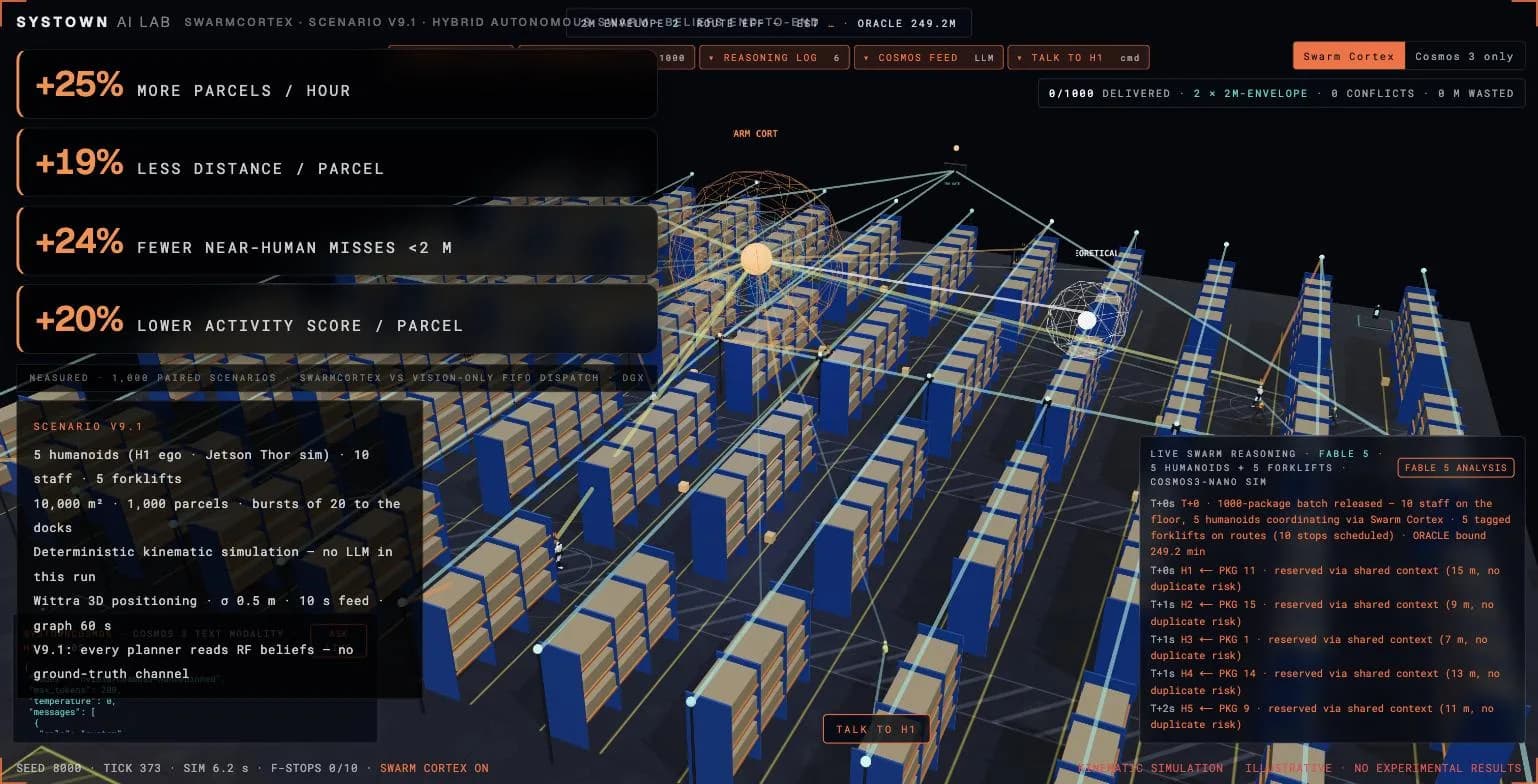
Five humanoids, five forklifts, ten staff, 1,000 paired seeds. With missionGRAPH + swarmCORTEX on top of NVIDIA Cosmos 3: throughput up, near-misses down. Method, numbers and the live system after your NDA.
+25.3%
units per hour vs vision-only floor
1,000 paired seeds · simulated
−23.8%
near-misses between machines and people
1,000 paired seeds · simulated
Unlimited
real-time AVEVA PI tags + AF Unified Namespace context on the graph
structure · industrial ontology · live
Sources: swarmCORTEX V9.2 / V10 evidence (paired-seed simulation, p < 5×10⁻⁵); AVEVA PI data plane commit 280420a. Simulation is always labelled simulated. No field claims. Method, numbers and the live system: after your NDA.
Also from Systown
One measured world. Four products.


Powered by