
Loading…
Enabling The Sovereign & Industrial Frontier
Powered by Mission Critical Agentic & Physical AI

Powered by

 Anthropic & OpenAI Frontier
Next · Sovereign agent workflowsAnthropic & OpenAI Frontier
contextCLONE · Sovereign agent workflows
Frontier intelligence. Declared control.
Give agents the right context and clear limits. Inspect every decision. Keep the authority.
Where it matters most
Built for work that matters.
Questions, answered
Agentic & Physical AI, explained.
What it does. Why it matters. What is proven.
Explore the AI definitions →What does Systown AI build?
The framework between intelligence and accountable action. missionSTACK for physical operations. contextCLONE for governed agents. Built in Stockholm. Meet the team
What is missionSTACK?
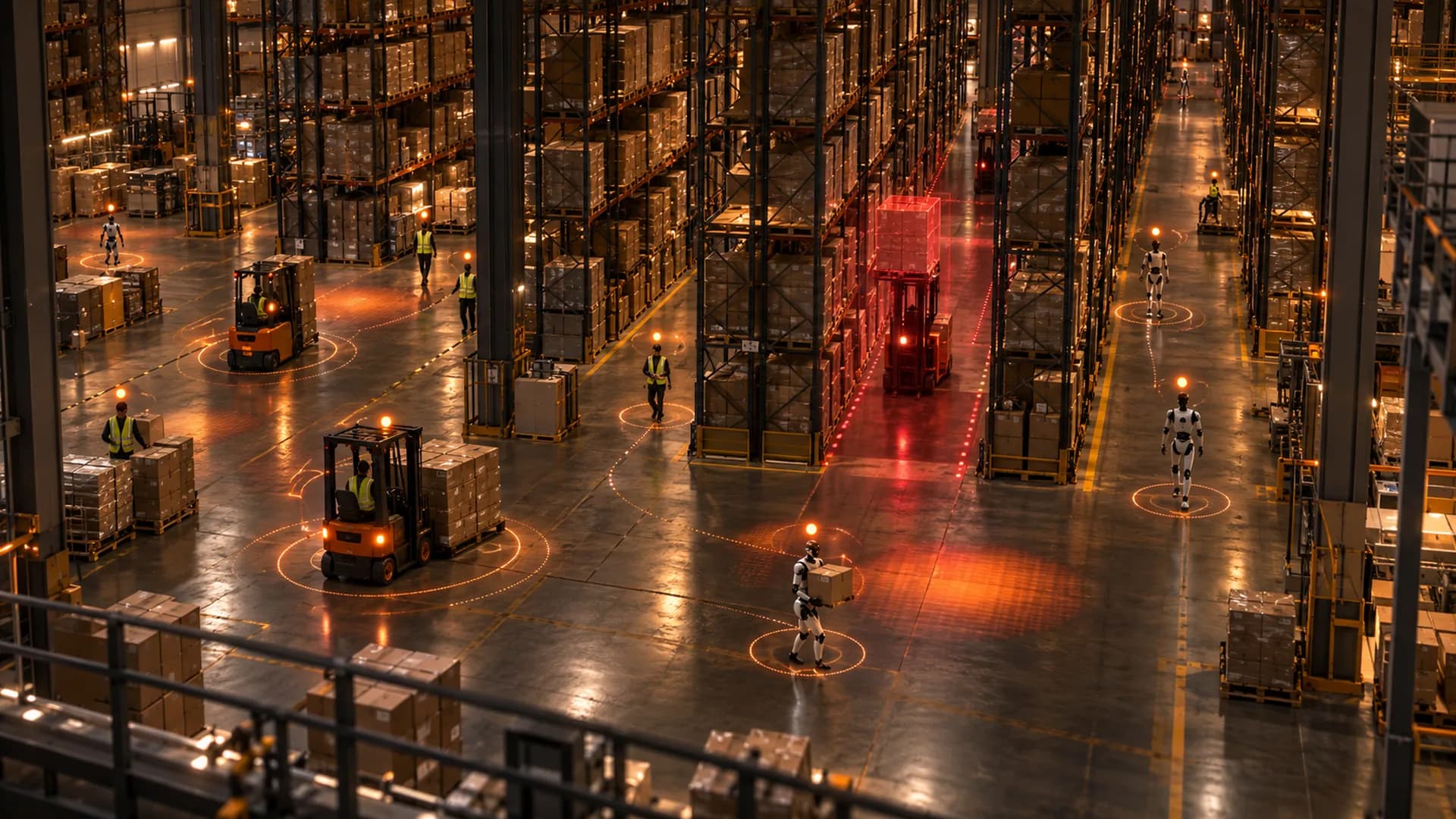
One industrial framework. missionGRAPH supplies context. swarmCORTEX coordinates. swarmREFLEX3 bounds responses. missionROS brings declared tasks to work cells. Current evidence is simulation-first. Explore the stack
What is missionSTUDIO?
The early-alpha missionSTACK workspace. Explore the operation, replay runs and inspect decisions. Hardware deployment requires separate commissioning. See the workspace
What is contextCLONE?
An agent-control architecture: approved sources, permitted actions, logs and reviewed versions. Each workflow requires implementation and runtime validation. Explore contextCLONE
What does missionGRAPH add?
A shared picture of assets, places and work, with source, time and uncertainty. Every coordinator and model starts from the same context. Explore shared context
Why does a fleet need swarmCORTEX?
Jobs, routes and resources are shared. swarmCORTEX coordinates them using a common operating picture. Simulation results need site validation before claiming field gains. See fleet coordination
What are swarmREFLEX3 and swarmREFLEX3-ROS?
The generation-3 reflex family for fleet and work-cell decisions. Separate contracts, fallbacks and evidence. Model cards retain the tested artifact versions. Read both model cards
What supports “up to 90% fewer world-model calls”?
98.3% median paired reduction across 16 E4 simulation seeds versus uncoordinated KNOW with Wittra tags. The result combines coordination and rule reflexes—not the learned model alone. Read the conditions
How fast is the local decision path?
Earlier model-v4 path: 24.75 ms p99 on DGX Spark CPU, from snapshot to durable journal. Separate from call reduction; not artifact 2.1 or ROS hardware timing. See the timing evidence
What does the Jev and Laya comparison show?
Accepted actions, harmful admissions and latency on a historical common task. CPU, GB10 and remote API paths differ; this is not a universal speed or superiority ranking. Inspect the comparison
How does missionROS reach arms and grippers?
Declared states sequence the task. Six contracts bound reach, grip, contact, slip, tool signals and clearance. Kinematic research does not prove real-arm performance. Explore the work cell
What makes the framework deterministic?
Declared states, guards and fallbacks. Recorded replay uses the same version and decisions without model calls. New model answers may vary. See declared control
How does the system improve?
Log. Replay. Evaluate. Propose. Review. Version. Evidence and an authorised reviewer admit the change; agents cannot silently rewrite the running workflow. Explore the improvement loop
How do AVEVA PI and Wittra fit?
Process history from AVEVA PI/AF. Spatial context via Wittra Adaptive 4D Mesh Sense. Validate permissions, mappings, coverage and calibration before live use. See measured-reality inputs
How are missionSTACK and contextCLONE different?
Physical work versus information work. Both ground decisions in context, bound actions and retain evidence for human review and versioned improvement. Choose your starting point
What does sovereign AI mean here?
Your authority over models, information and actions. Connected, Protected and Sealed are architecture options; the installed system must demonstrate the boundary. Review deployment profiles
Does the framework replace equipment safety controls?
No. Physical equipment needs its own safety controls, sensing coverage, operating limits and commissioning. Simulation and model gates do not replace them. Understand the boundary
What business value can missionSTACK deliver?
More output from the same fleet. Coordinate machines, keep routine decisions local and carry tasks to arms and grippers. Our simulation-informed target is up to 20% more throughput at fixed cost—equivalent to 16.7% lower cost per unit. At an assumed $80,000 annual cost per machine, that is about $13,300 in annual cost-per-output value before platform costs. This is an illustrative scenario, not measured savings. Validate throughput, avoided costs and total costs at your site. Explore fleet coordination
What assumptions sit behind the industrial market scenario?
Citi’s December 2024 forecast is 1.337 billion AI robots across all sectors by 2035. Our assumed industrial market is 100 million autonomous machines, about 7.5% of that total. At $80,000 per machine per year and 20% more throughput at fixed cost, the illustrative annual cost-per-output value is $1.33 trillion; an assumed obtainable market of one million industrial humanoids represents $13.3 billion. These are scenario assumptions, not measured savings or Systown revenue. Citi forecast table · page 4
Where can we start?
One bounded industrial, public-sector, healthcare-administration or security workflow. Use approved samples and named reviewers. Healthcare examples concern administration, not clinical decisions. Explore applications
What do we need for an evaluation?
One task. Approved samples. An accountable owner. A measurable result. Agree the baseline, controls and evidence for the next decision. Start the conversation
Start the conversation
One mission.
A clear next step.
Tell us what needs to improve. Define the result. Test the path to it.
Start your evaluation →