
Site reasoning
Relate production sequence, equipment state, quality release and part location to station demand and permitted routes.
Loading…
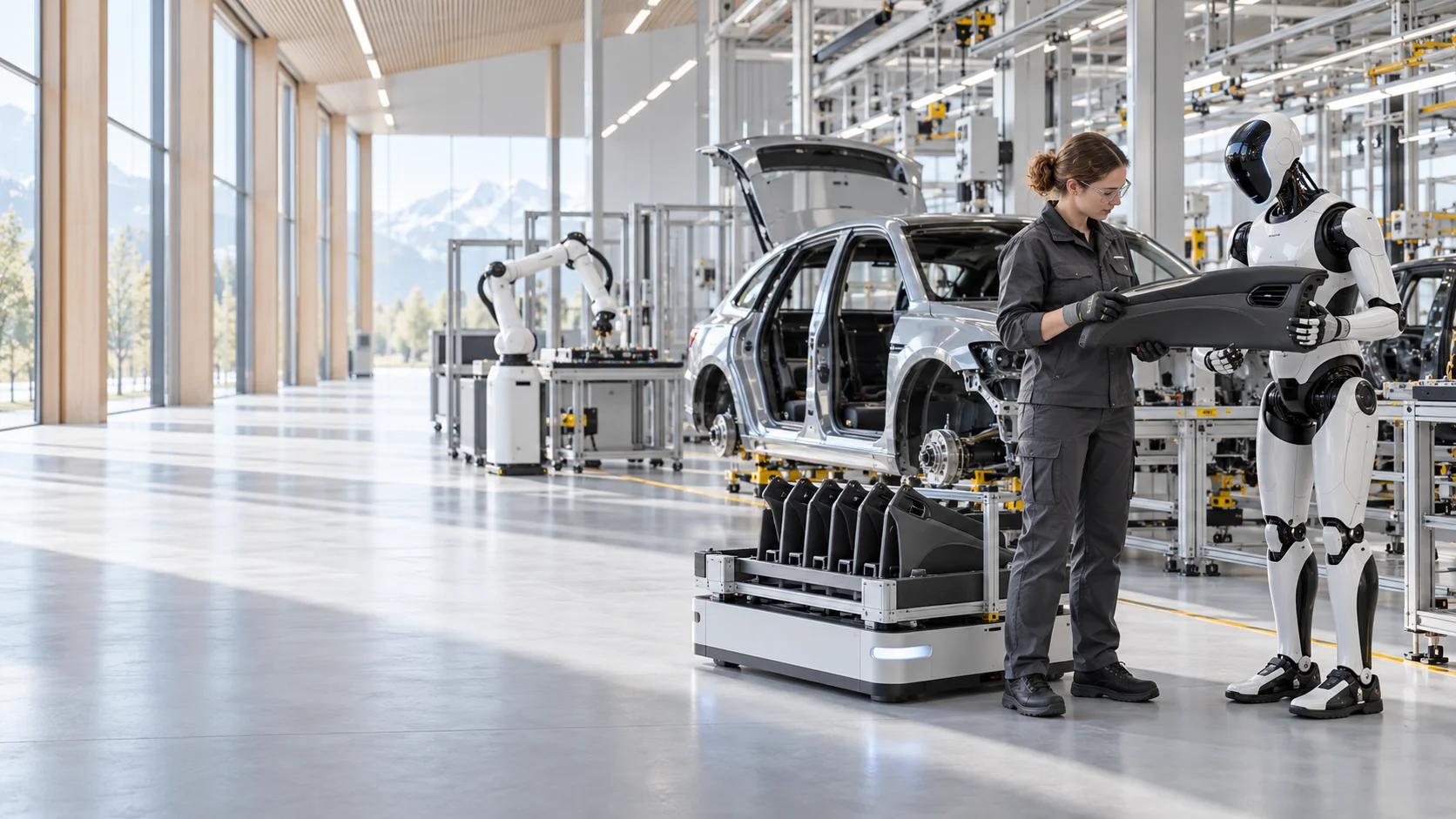
Systown AI · Car manufacturing
Connect assembly sequence, parts availability and mixed robot fleets.
Relate production sequence, equipment state, quality release and part location to station demand and permitted routes.
Coordinate AMR and AGV deliveries, industrial arms, cobots and humanoid support with the assembly team.
Fewer parts-related line interruptions, better sequence reliability and less time spent on expediting and repeated handling.
Example workflow and intended business benefits. The site, equipment and operating scope determine the application.
Concept illustration
Next · Questions answeredQuestions, answered
Connect assembly sequence, parts availability and mixed robot fleets. Relate production sequence, equipment state, quality release and part location to station demand and permitted routes. Systown AI proposes connecting that site context to reviewed workflows and coordinated physical tasks, with the operating scope and supported interfaces agreed for the site. Explore site context and coordination
Coordinate AMR and AGV deliveries, industrial arms, cobots and humanoid support with the assembly team. Select the robot, tooling and interface around the task and environment. People define the permitted scope and handle exceptions; equipment controls retain their roles. These are example workflows requiring application-specific qualification. Explore coordinated task responses
Fewer parts-related line interruptions, better sequence reliability and less time spent on expediting and repeated handling. These are intended benefits of the proposed workflow, not measured customer results. Start with the operational bottleneck, agree the baseline and define the business outcome with the accountable team before expanding the scope. Discuss your operation